Media Madness: Donald Trump, the Press, and the War Over the Truth by Howard Kurtz
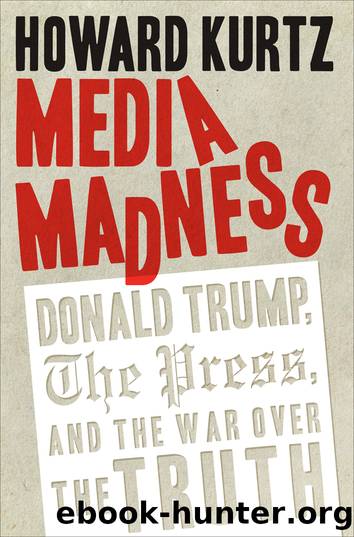
Author:Howard Kurtz [Kurtz, Howard]
Language: eng
Format: epub
Tags: political science, Political Ideologies, Conservatism & Liberalism
ISBN: 9781621577560
Google: tO07DwAAQBAJ
Publisher: Simon and Schuster
Published: 2018-01-29T20:28:44.366709+00:00
CHAPTER 17
THE MEDIA GO TO DEFCON 1
The Washington Post newsroom broke into applause when the numbers flashed on the video monitor.
The Postâs explosive story on Donald Trump and Russia had just broken the clicks-per-minute record on its website, previously held by the paperâs posting of the Access Hollywood tape.
On May 15, the Post reported that during an Oval Office meeting with Russiaâs foreign minister and ambassador, Trump had disclosed highly classified dataâdubbed âcode wordâ informationâabout an ISIS terror threat involving laptops on airplanes.
The information was so sensitive that the Post withheld most details of the plot at the urging of federal officials, and senior White House aides contacted the CIA and NSA to discuss the possible fallout.
The White House press team moved quickly. Raised voices were heard as Steve Bannon met with Sean Spicer and his staff in the Cabinet room. H. R. McMaster, the new national security adviser (and someone that the White House told the Weekly Standard that Trump held in high esteem, precisely because there were leaks that he didnâtâthat he lectured Trump and lacked rapport with him), was tapped to read a statement.
The blunt general did his duty. McMaster said the Washington Post story was âfalse,â that he had been in the room, and that âat no time were any intelligence sources or methods discussed.â The article, however, hadnât said that sources or methods were compromised, although the leak could have led to that. It was, in journalistic parlance, a nondenial denial.
The paper acknowledged that no law had been broken because the president has the power to declassify information. But the storyâs obvious news value was enormously amplified because it played into a larger media narrative: that Trump would do anything to help the Russians. That Trump was too unsophisticated to grasp the nuances of intelligence matters. That Trump was a danger to national security.
Glenn Thrush of the New York Times snarked on Twitter about âReported fact-chain: 1) Comey requests more $ for Russia probe 2) Trump cans Comey 3) Trump invites Russians to Oval, divulges state secrets.â Even if he hadnât included the debunked story about Comey having asked for more resources, the tweet conveyed a reporterâs view that Trump was an unwitting tool for Moscow.
Less than twenty-four hours later, the Times quoted from a James Comey memo, read by an unnamed associate, saying the president had suggested to him that he drop the Michael Flynn investigation: âHe is a good guy. I hope you can let this go.â
The media went to DEFCON 1.
The instant consensus was that this was an obstruction of justice, a scandal of Watergate proportions: the president was trying to pressure his FBI director to stop an investigation of his former national security adviserâs ties to Russia. It was a slam-dunk case! Donald Trump had finally been exposed.
Joe Scarborough spoke of âa president that is increasingly isolated, increasingly enraged, and increasingly out of touch with the realities of what is required to run this office.â
Lawrence OâDonnell announced that âDonald Trump now sits at the threshold of impeachment.
Download
This site does not store any files on its server. We only index and link to content provided by other sites. Please contact the content providers to delete copyright contents if any and email us, we'll remove relevant links or contents immediately.
Spell It Out by David Crystal(36243)
Life for Me Ain't Been No Crystal Stair by Susan Sheehan(35904)
The Great Music City by Andrea Baker(33722)
Cecilia; Or, Memoirs of an Heiress — Volume 1 by Fanny Burney(32726)
Cecilia; Or, Memoirs of an Heiress — Volume 2 by Fanny Burney(32090)
Cecilia; Or, Memoirs of an Heiress — Volume 3 by Fanny Burney(32068)
Professional Troublemaker by Luvvie Ajayi Jones(29763)
The Secret History by Donna Tartt(19476)
We're Going to Need More Wine by Gabrielle Union(19176)
Twilight of the Idols With the Antichrist and Ecce Homo by Friedrich Nietzsche(18784)
All the Missing Girls by Megan Miranda(16734)
Cat's cradle by Kurt Vonnegut(15559)
For the Love of Europe by Rick Steves(14931)
Pimp by Iceberg Slim(14804)
Bombshells: Glamour Girls of a Lifetime by Sullivan Steve(14221)
Norse Mythology by Gaiman Neil(13575)
Talking to Strangers by Malcolm Gladwell(13556)
Fifty Shades Freed by E L James(13352)
The Social Justice Warrior Handbook by Lisa De Pasquale(12297)
